
Oh, my God, did you bring questions for
me
?
I, no, but I do have something out of fairness,
before we begin.
I want to read Mr. Kushner's lawyer's denial, part of it,
before we start.
No serious.
You want to read it before we start?
Yeah.
OK.
Uh quote--
Is this a bit or is this real?
It's very real.
OK.
This is from his lawyer.
-
This is from his lawyer. -
To you.
To me.
So he has your email.
"Mr. Kushner never accessed foreign accounts and always
followed all rules and regulations,
and only pursued goals that were in the best interest
of the United States, as directed by the President
of the United States."
So I just want to get that out of the way, because it's
important, no, it's important to note
that Kushner unequivocally and emphatically denies
everything in this book.
I mean, everything.
Well, am I in trouble now?
What the [BLEEP]?
What are you doing?
I think you're good.
He's denied.
Did he see the book before it went to--
Well, let's tell people what's in the book first,
so that they have a context for what they deny.
It-- it is a wild yarn.
It is a wild story that is being told here.
We're all familiar with Mohammed bin Salman and
other Arab leaders put a lot of money into his Affinity Fund,
and he manages that.
And it's about $5 billion, $6 billion.
I think everybody's aware of that
and the conflict of interest that that appears to hold.
This is a different.
This is not that. -
Right.
It's very distinct from that.
So what is this?
What the book lays out largely,
is how Jared Kushner ran essentially,
a shadow foreign policy while he was in the White House.
This is the first Trump term, not the second.
This is the first Trump term.
This is as a senior advisor to the president,
as a White House official.
And it's, what we see is, going back
to The very beginning of the Trump, Trump's first term
in 2017, was he found common cause
with MBZ, Mohammed bin Zayed--
Now MBZ--
Yeah.
We all know MBS.
We didn't know there was an MBZ.
Are there MB--
Some of us did.
Is there an MBA through Z?
Do they, Mohammed bin Adam and then they just keep going?
It's-- it can be difficult, and
it's a bit of an alphabet soup, but
it's important to understand.
OK.
MBZ is the ruler of the UAE.
UAE OK.
And I would say individually, he's worth somewhere,
it's estimated, but like literally $1 trillion, OK?
I mean, $1 trillion.
So very hard to put in real terms
how much money this man has.
And as the ruler of this tiny country,
he uses that money more than anything else,
to buy friends and frenemies.
And so part of the story is how Kushner gets-- embraces,
there's sort of a joint embrace.
He's considered a moderate in the region.
He's-- -
Very moderate.
--very much against extremism.
Beloved, he's beloved in the West.
Beloved.
And-- and some of that is because his--
he does-- -
$1 trillion.
Well, I, I will tell you that one
of the working titles for this book early on was,
No One Can Say No.
Because that's what it's like when
you're reporting on the people who are
around MBZ from any country.
They offer money.
No one can say no.
I mean, just on a, I don't mean illegally.
I just mean-- -
Them and the Saudis.
Look, Phil Mickelson couldn't say no.
None of them.
Right.
They give money to every, they buy everything.
And so what-- what you find is,
is that Kushner and Trump came into office and they
wanted the great peace deal.
They wanted to solve the Middle East peace, Middle East
conflict, which was Israel versus Palestine,
Israel and the Palestinians. And--
Is that still going on?
I didn't finish the book.
Well, the-- the issue for them,
is that under America's first policy,
Trump wasn't going to spend any money.
He wanted to pull troops out.
And what Kushner found in MBZ and in MBS,
were two rulers who were welling-- who
were willing to pay for it.
They were going to bring the financial side
to try to get the Palestinians to the table to accept a deal
that was favorable to Israel.
And that's the second part of-- of Kushner's background, which
is, he was close to Netanyahu politically
in terms of Israeli politics and security.
He's very to the right.
He's essentially a member of the Likud Party.
And I don't mean literally, but--
Right.
And it's important to remember that.
And these two, a little shading on there
is, that MBS And MBZ are both upset with
the Obama administration--
Very.
--because of the Iran deal that they signed.
And also, their support of Arab Spring.
Absolutely.
Autocrats, they're not big on freedom movements.
That's exactly it.
And so you have these two sides coming together--
Yes.
--perfectly aligned, which is, the Gulf Arabs were
furious about the Iran deal.
They wanted it gone.
They wanted to not just thwart Iran,
but they wanted to hurt Iran.
They were hoping to topple Iran.
So they all agree with each other
and they all have their-- their policy goals all aligned.
Exactly.
-
MBZ, Trump, Kushner. -
Exactly.
And Israel at the time. -
And Israel at the time.
And Israel, too.
But what happens is, is that Kushner finds himself
in a position in the White House
with no statutory authority.
He comes into office, just to remind everyone,
he had no experience.
He gets the job because he's the-- the son-in-law.
-
No. -
He gets, he gets--
Now you're pushing it.
He-- he's given perhaps the most
consequential position in terms of foreign
policy in the administration.
And because he's not been vetted or confirmed
by the Senate, he's not a cabinet member,
he essentially has no oversight.
And doesn't have security clearance for a while.
Well, for a while, right, and that's in the book,
too, because that's an important issue.
He was essentially working just for the president, right?
Now he will say, in fairness, he had rules and laws and
regulations that he followed.
And it's true.
But there was essentially no oversight.
And so you have this someone who
is, let's just say, underqualified,
who gets into this position and immediately finds
himself aligned with two of the wealthiest men
in the world who are seeking US support
and top cover for remaking the Middle East in their favor.
And when that happens, what we know is that Kushner--
and Kushner has said this, right?--
his diplomacy, Trump's diplomacy, is business.
It's a real estate negotiation.
And so diplomacy becomes very transactional.
And at that point-- and we can get into more about
what triggers some of this--
all of a sudden, what appears are
some secret financial agreements and
arrangements between the three of them,
between MBS, MBZ, and Kushner.
So you get into a--
Secret financial agreements.
If they all agree, why are there secret--
if they all agree on what to do,
what are the financial agreements about?
Well, that's-- that's what we're getting
into with the accounts.
So what happens is, is that there's-- there's an
original idea.
MBZ and MBS float this idea to Kushner early in 2017
that there should be a $10 to $12 billion
foreign policy fund, not like overt, essentially an idea
that put money together.
And we're going to support Donald Trump's foreign policy
initiatives, and overtly.
So, for instance, one of the things that I was told
was an example of an idea that they
had, was they were going to fund the wall down in Mexico.
That was one idea.
Like, they're going to spend the money
to build the wall for Trump.
And the idea is, is that Trump could then run for reelection
and get a second term with all of these accomplishments.
But for reasons that are not totally clear, but
in part because it was very cumbersome,
that idea sort of falls away.
And lo and behold, in its replacement
is a similar fund or slush pool of money, let's call it,
for Kushner to operate with and to remake
the region because these two guys, MBS and MBZ--
And isn't that--
isn't that the United States Treasury?
I mean, we're not-- isn't that what we do oversight?
How do you mean?
Isn't that the story of Iraq and Afghanistan,
that we have a pool of money, sort of like a slush fund?
I mean--
Well, that's our money.
This is specifically money from the UAE and Saudi Arabia.
And so what-- what--
the first, let's just call it the first pool of money,
and what I in the book call the alpha account,
looks a lot like Iran-Contra.
This is a pool of-- this is a pool of money that is meant
to remake the Middle East.
A lot of the money went to trying
to support the war at the time, the conflict in Libya
and overthrowing the government in Libya.
And there was a larger view, as you laid out, anti-Iranian,
fight back against Iran, undo, but
the other part was to really, really undo
the last of the Arab Spring.
And so, for instance, in Libya where
there had been a overthrow and Gaddafi goes down,
they want to put in a wannabe dictator,
the next dictator in Libya.
And so the support and the money in some of that account
starts to flow into there.
Then you get into-- this is where it gets--
what I like to say is, and I think
it's really important for readers to know,
is that what Jared--
Jared Kushner found himself into
is kind of like a Game of Thrones
like scenario with these three Arab rulers.
You have MBS and MBZ, Saudi Arabia, and the UAE.
And then you have Qatar. -
Sure.
And so--
And they're at odds with--
And they're at odds.
And so here's-- here's how it goes.
In June of 2017, MBS and MBZ team up and
announced that they're going to start a blockade against Qatar.
They're sick of the ruler of Qatar.
They want him-- they're sick of Al Jazeera.
They want him to stop funding the Muslim Brotherhood and--
Because they feel like that generates unrest
amongst the hoi polloi that is threatening their autocracies.
Exactly.
In the end-- in the end, all of this
is just about power and self-preservation.
In those countries, the ruling family is the state.
And so preserving Saudi Arabia really just
means preserving MBS, and likewise for MBZ.
And so they start this blockade.
And a lot of it was also that they
couldn't control the Qataris.
Qataris have a lot of money. -
Yes.
And they didn't want to listen to MBS.
And the Qataris are funding Iranian proxies
through the region, which is Hamas and Hezbollah and those.
And they're-- they're hosting.
Some of that is, yeah, absolutely.
And-- and so they had been at loggerheads.
But they also host a huge American
base with 10,000 troops.
And so they're-- they're all allies of the United States.
JON STEWART: Sure.
And so-- well, and that's one of the things--
I mean, that's a central component of the book is like,
do allies try to use money to buy
people to influence the President of the United
States directly?
Apparently.
And-- and-- so--
But why all the subterfuge?
I mean, they do it out in the open.
They give them a $400 million plane.
Well, that's the--
I mean, actually, what this story is, is the origin story.
This book is the origin story of how we got there.
JON STEWART: OK. -
OK.
What I've done, and I think what the reporting is,
it is lifting the veil on 10 years of really deep, dark
secrets that have been going on in the Middle East,
with Kushner as a central component of it.
Now, how do you know that he is a central other than he's
part of the diplomacy and he's trying
to do the Abraham Accords and he gets them done?
How do you know that he's part of this through subterfuge
and this-- this $10 or $12 billion fund?
OK, well, first of all, let's just point out-- the $10 or
$12 billion fund disappeared.
It-- it didn't happen.
It didn't materialize. So--
Well, there was no fund.
No wait.
This starts with-- the idea starts with--
You're killing me, Smalls.
We go from 10 to 12, and it doesn't work out
to here's 2 billion, and we're going
to split it up into two pots.
And that becomes the secret bank
accounts-- the alpha account and the beta account.
And those accounts-- -
A billion each.
Roughly.
One is held in the UAE, and one is held in Israel.
And--
And it's literally held like Abu Dhabi Bank, Bank of Israel.
Yeah, Central Bank of Israel--
Central bank.
--and the first Abu Dhabi Bank--
Sure.
You don't want to be in the second.
Yeah yeah yeah.
--in the UAE.
And one of those accounts, as I said, it's like Iran-Contra.
That's money that goes to Libyan dictator, the founder
of Blackwater, Erik Prince.
It went to a Cuban hitman who worked for both
the CIA and the Mossad.
What is their role in this?
Well, they are taking money and moving weapons and
trying to arm Haftar in Libya.
And so-- and that's why I'm saying what the-- the--what
the fund looks like, is a foreign policy fund that
the UAE is operating, and that Jared is, just by having access
to the account, has embraced.
Because what this is really all about is--
He has access to the account.
Yes, he has access to--
How?
Well, he was a signatory on the account,
according to my sources.
And so--
He's a signatory.
-
Let-- -
OK, may I?
-
Yes. -
Or you want to?
No, no, go ahead.
I'm going to assume these guys are sophisticated
and understand the laws of cryptocurrency
and money laundering and all these other issues.
That seems very above board for a way
to launder a slush fund through hit men and strongmen,
like we do that through the CIA anyway.
So why-- I don't understand--
Actually, so you've hit exactly it.
The UAE has been obsessed.
Mohammed bin Zayed has been obsessed--
Yeah.
--essentially with replicating CIA covert
operations, CIA-like covert operations around the Middle
East and North Africa.
For years they've been doing it.
It's a very murderous regime.
And so what they did was, they put money
into a bank account controlled by a charity,
a domestic Emirati charity that the UAE uses
for covert arms shipments.
OK?
And that's the, wait--
His name is on it, Jared's?
No, I didn't say his name was on it.
I said he was a signatory, which meant
it gave him access to it.
And we know that he had access to it,
because when his phone was hacked
in 2017 by the Dutch intelligence service,
they saw his access to the account on his screenshots,
on his phone.
The Dutch intelligence services.
Yeah.
It's a wild story.
Yes!
No question.
Wait wait wait.
And just to put it out there, the hacking
of his phone is actually, and-- and everything that's in here--
The Dutch hacked Jared Kushner's phone.
They are NATO allies.
They had an operation.
They got themselves into access into a Russian GRU server
in 2017.
When they get into the server.
The Dutch.
Yes.
They find that the Russians have gotten into Jared's phone.
And it set off alarm bells.
The Russians hacked Jared's phone.
Yes.
What the hell is going on here?
Thank you.
They follow that up by deciding that they also want
to get into Jared's phone.
And when they get into Jared's phone--
I'm sure it's just dick pics.
What was, I don't even understand.
Like what?
So the, you-- you, OK.
So just, let me, follow me here.
OK.
So, after the Dutch access the phone, what
they start to see are, they see an access
to an account in Abu Dhabi at the First Abu Dhabi Bank, OK?
And-- on Jared's phone.
Now they can't control his phone.
They can only see the phone when he's using it.
So it's like screenshots.
And--
And he's literally like, Venmoing a guy in Libya.
No.
What-- what they see, is an account, a bank account.
And that bank account starts to show money flows in from a bank
from Azerbaijan.
And they have in from Azerbaijan into the UAE.
And the Dutch are looking at it going, what is this?
And then the money starts to pool there
and starts to go out.
And the first, for instance, the first transfer
out from that account went to Erik Prince,
the founder of Blackwater.
The second one went to Khalifa Haftar in Libya.
You've seen the statements.
You've seen bank statements.
I'm not going to get into my sourcing.
As a reminder, just as a reminder--
Yeah.
--this is serious.
Last year, I wrote a story with a colleague
for The New York Times about a secret SEAL Team Six
commando raid in North Korea--
North Korea.
--that failed.
My reward for that, is to receive a subpoena to testify
before a grand jury.
And your phone's been hacked by UAE, as well.
And my phone has been hacked by the UAE.
So protecting my sources is critical.
Understood.
Can you, without giving up sources,
just say you have witnessed this,
and it's not just verbal hearsay, like,
I know a guy in the Dutch intelligence--
-
I can't-- -
--that I trust?
I can't say anything.
I can't say anything beyond what, as I have
it in the book, which is--
But when they're going to, like, they're going to sue you.
You're going to have to say something, no?
Well, I mean, I think the issue
is, I can't speak to whether they're going to sue me or not.
I listened to their denials.
I took them in, I went back to some of my sources,
and I'm very confident that I have the story right.
And so if that comes, I'll deal with it when it comes.
Right.
This is a story that the public needs to understand
and see and hear, to figure out how we went from 2017 when
Donald Trump went into office, to how
we ended up in a war in Iran.
Because it is the same arc, and it starts there in 201--
Right.
--when Jared Kushner meets privately and secretly
at the time in Manhattan's, in the Four Seasons in Manhattan
with MBZ.
Right.
Because they had-- they start a bromance.
And that bromance is about--
That's so, like, everything is so spy vs spy,
and then you end with bromance?
Come on.
Look, this is really serious stuff.
It is.
But-- but the reality is, is right--
Let me, let me just push back for a moment.
Yeah.
So your theory of the case makes total sense to me,
but it makes total sense to me in the world
of things we already know.
MBZ and MBS, they don't like Iran.
Netanyahu doesn't like Iran.
They're working together at cross purposes.
They don't really seem to care about the Palestinians.
Everyone seems very willing to sell them out.
They have people in the Trump administration
who are fellow travelers in that larger project,
protecting Israel, weakening Iran,
and strengthening the autocracies
that are in the Middle East.
There are giant funds that don't
seem to make any sense that Kushner, Witkoff and them,
they go through and they do the diplomacy.
They, like, all of this makes sense with things
that we already know.
But it feels like introducing all the subterfuge with stories
that sound harder to wrap your head around,
like the Dutch hacked Jared Kushner and didn't tell
the Americans-- or the Dutch found out that the Russians
hacked Jared Kushner-- -
Here's a better question.
--and didn't tell the Americans.
Why would the Dutch tell the Americans
that they hacked the president's son-in-law's phone?
If they made that--
We're [BLEEP] allies.
Yeah.
But at the time, they were terrified,
as were most of NATO allies--
most people in NATO, most countries in NATO-- that Trump
was a Russian spy, right?
That he was a setup.
And so when they see money flowing from Azerbaijan,
they have this question--
OK.
Why didn't they talk to the Biden administration in 2020?
I mean, intelligence agencies spy on countries--
that's literally what they do.
OK.
OK.
And they don't talk about it.
But this is a big megillah.
And you're asking us to go with you on a big megillah--
not for a story that seems implausible in the sense
that money laundering is rife, but,
like, it does beggar belief when you think,
like, why wouldn't they do this through crypto or shit
that you can't trace?
Like, signatories to the First Bank of Abu Dhabi
and the Central Bank of Israel seem crazy.
I think-- first of all, you've read the book, right?
-
I have. -
OK.
Did you enjoy it? I mean--
I did. [LAUGHTER]
Would you recommend--
would you recommend it to others?
I don't think most people are readers.
[LAUGHTER] -
OK.
That's not much of a--
I think most people are waiting for the book.
OK.
No, it is--
it was a frustrating read, if I'm being honest.
OK.
It's a story that I believe on theory, but I felt like--
oh, this is going to sound crazy--
it felt a little like religion.
I get the general, like, there might be something in the sky
that's bigger than all of us.
But once you get down to, like, and he's a carpenter--
then I'm like, OK.
[LAUGHTER]
And I think that, for me, was part
of the problem is when you get into some of the specifics,
they raise so many questions that I began to question
the entire narrative.
And if I can question the specifics,
it felt like it undercut the larger story.
OK.
And that's fair.
And what I want is people to read it and come up
with their own decision or their own sense
of what they think.
I'm very confident that what is in there--
I'm sitting here very confident that what is in there is true.
And I'm fully behind it.
And the real issue, I think, is that, one, all of this stuff
is complicated. JON STEWART: Yes.
You have--
I mean, I didn't even get into the breakup
between MBZ and MBS, right, because they had a bromance.
And then they broke up.
And right now, they're very broken up.
I was really rooting for them.
[LAUGHTER]
And so then they each individually are
trying to wrap their arm around Kushner
and take him away from the other.
I mean, there's a whole element of that, right?
And so it's not easy stuff.
It's journalism.
And journalism isn't always-- investigative journalism,
in particular-- doesn't always have the perfect ending.
You know, what's frustrating, I think, partly,
is that when you're talking about foreign policy
and all of these powerful people who
are interested in preserving their own ends
and achieving their own ends is they break apart,
they come together.
It's not dissimilar-- it's like watching Trump and
Netanyahu right?
When they need each other, they're together.
Then they hate each other, and they're apart.
So that is the connection here.
But there was a central element to it,
which were these secret financial transactions
and deals between MBZ, MBS, and Kushner.
Right.
But, ultimately, for the veracity of it,
people are going to need more than,
like, take my word for it.
I believe it.
That's my only point.
And that within that, that's going to ultimately end up
being a tough sell if you, for reasons that may seem very
reasonable, to protect your sources-- and you've been
burned in this area before--
it would make sense.
I'm just concerned that, like--
this book's a big swing.
Sure.
Like, no question.
I would say two things.
Number one, I think we are in a place
right now in this country where most people can
see there's something wrong.
JON STEWART: Yes.
OK.
[LAUGHTER]
This book, for me, started five years ago.
I pulled a thread.
I followed that thread for five years.
But are you worried that this is the Steele dossier?
That this is Christopher Steele--
No no.
--selling a pee tape.
And you go on shows and go, there's a pee tape.
No.
And that puts you in a position--
you don't worry about that? -
No.
I think-- no, no.
I think that, look, journalism is imperfect.
It's often described as the first draft of history.
JON STEWART: Yes.
And just because I don't have--
the book doesn't have every answer to every
question or it prompts more questions,
to me, that's the point.
That's the purpose.
We have to understand--
JON STEWART: This is an invitation.
--what the hell happened.
And let's figure out-- what I'm bringing
is the tip of the iceberg in terms of Trump's
corruption OK?
The Trump administration's corruption
that started in the first administration, OK?
And I don't know how big it is beneath the surface,
but I know it's a lot bigger than the tip.
And so I'm pushing it there.
[LAUGHTER]
The book is called It's A Lot Bigger Than the Tip.
[LAUGHTER]
[APPLAUSE]
It is a great invitation.
And I do urge people to read it.
It is a fascinating story.
It certainly corroborates a worldview that, I think,
most people believe is the underbelly
of international intrigue.
And we certainly know stories of America
feeding cash to warlords and manipulating governments.
It's not like anything--
This was just done in reverse.
In reverse.
Right.
But, obviously, I'm certainly not the only one--
like, I'm on team you.
And so for me to go like, hmm, is the only thing I'm saying.
And I hope that, obviously--
I respect that.
And I appreciate you having me.
[APPLAUSE]
You know what?
Wait, hold on.
Are we having a bromance?
[LAUGHTER]
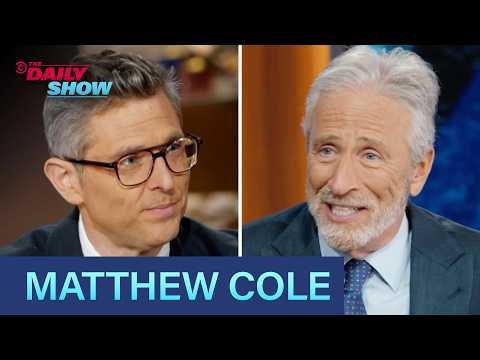
The book is Princes and Thieves.
Matthew Cole.
0.5x - Slower
0.75x - Slow
1.0x - Normal
You might also like these videos



If you enjoy using our custom video player, why not join thousands of subscribers who have signed up to our free weekly lessons?